Why Your Marketing Is Generating Leads but Not the Right Leads
When your website traffic is growing, form submissions are coming in and the phone is ringing. On paper, marketing appears to be working.
Then you look closer. The calls are for services you do not provide, prospects are outside your service area and people want the cheapest possible option when that is not the type of customer you are trying to attract. Others fill out a form but were never serious about hiring you.
That is a lead quality problem.
Learning how to improve lead quality usually requires looking beyond the number of leads generated. The real question is whether your marketing is attracting people who need the right service, are in the right market, and have enough intent to realistically become customers.
More traffic will not necessarily fix that. In some cases, it simply produces more of the wrong inquiries.
Start by Defining What a Good Lead Actually Means
Before changing campaigns, keywords, or website pages, define what makes a lead valuable to your business. For a home service company, that might mean someone who:
-
Needs a service you actively offer
-
Lives within your actual service territory
-
Is the homeowner or decision-maker
-
Has a problem your team is equipped to solve
-
Is looking to hire within a reasonable timeframe
-
Fits the types of jobs your business wants to pursue
A roofing company may care about project size and property type while an HVAC company may prioritize replacement opportunities differently from minor service calls. A commercial contractor may consider a homeowner inquiry completely irrelevant even though the person technically submitted a legitimate request.
This is why lead volume alone can be misleading. You first need a practical definition of a qualified lead. Then your marketing data can be evaluated against that definition.
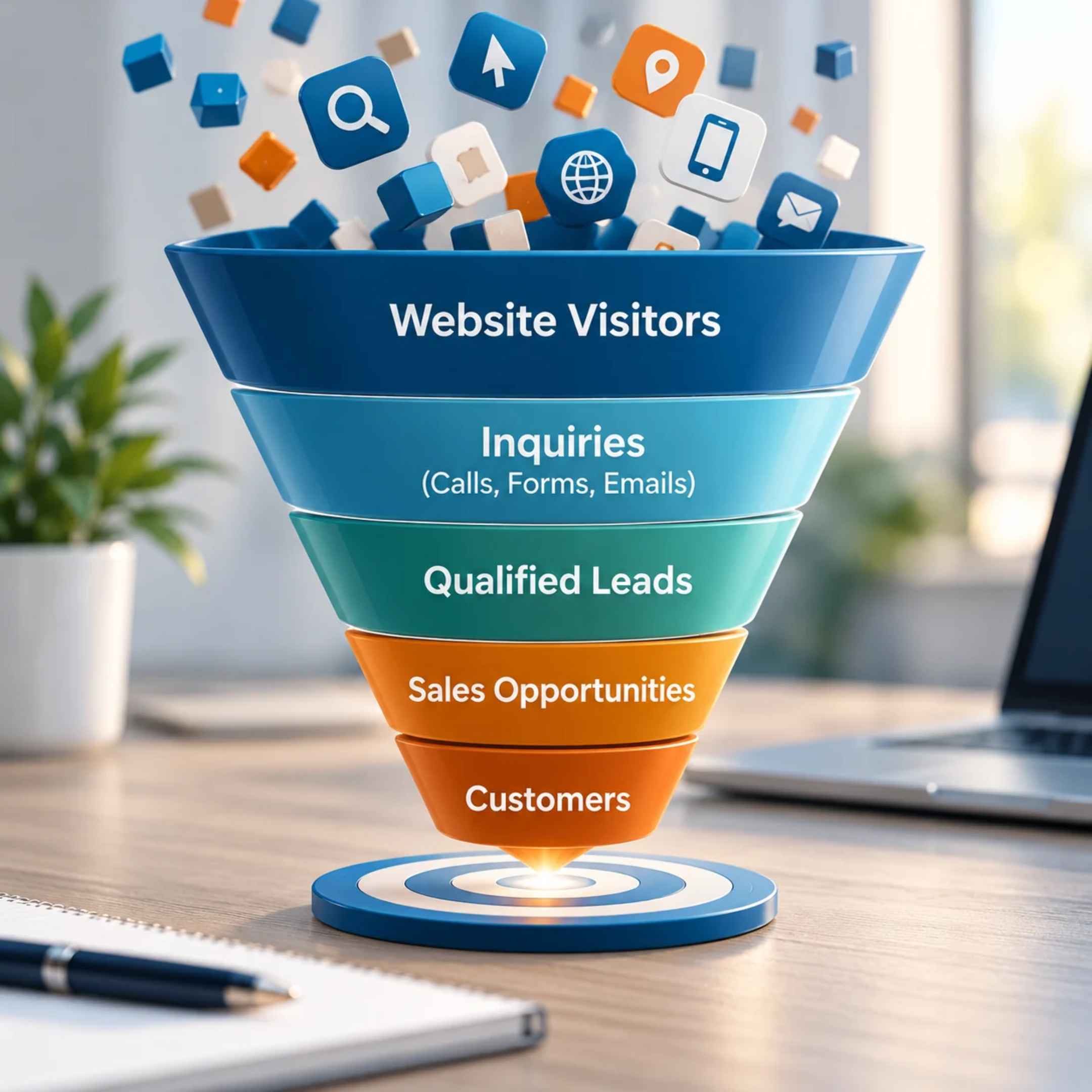
If you are not currently connecting marketing sources with what happened after an inquiry, start with a lead-tracking process that records whether each lead was qualified, unqualified, spam, an opportunity, or ultimately became a customer.

How to Improve Lead Quality by Looking at Search Intent
One of the first places to investigate is the language bringing people to your website or ads. Two searches can appear closely related while representing very different potential customers.
Someone searching for “furnace repair near me” is probably in a very different stage than someone searching for “how does a furnace work”. Both searches involve furnaces but only one clearly indicates an immediate service need. This matters in both SEO and paid search.
For SEO, review which pages are attracting organic visitors and what kinds of searches those pages appear for. An informational article can generate substantial traffic without being expected to produce the same kind of leads as a service page.
For paid search, examine the actual search terms triggering your ads rather than looking only at your target keyword list. Google’s Search Terms report shows searches that resulted in an ad being displayed and can help advertisers identify irrelevant queries, adjust match types, and add negative keywords.
Traffic is not automatically valuable because a search contains one of your service words. Intent matters.
Your Targeting May Be Broader Than You Think
A business can choose the right keywords and still generate poor leads because the audience or geographic settings are too broad. This becomes particularly important for local businesses.
Suppose an electrical contractor serves a defined portion of Chicagoland but keeps receiving inquiries well outside its practical service territory. Before assuming the ads are simply performing badly, review how geographic targeting is configured.
Google Ads location settings can include people physically located in a targeted area as well as people who have shown interest in that area, depending on the campaign settings being used. Google also allows advertisers to use location exclusions and more restrictive presence-based targeting when appropriate.
That does not mean every local campaign should automatically use the most restrictive setting. It does mean geographic settings deserve investigation when out-of-area leads become a recurring problem.
Other targeting questions matter too. Are campaigns focused on residential customers when commercial work is the priority? Are ads running during times when nobody can answer the phone? Are campaigns promoting every service equally even though certain jobs are much more valuable to the business?
Good targeting is not simply about finding more people. It is about reducing the distance between the people seeing the marketing and the people the business actually wants to serve.
Check Whether Your Offer Is Attracting the Wrong Customer
Lead quality problems are not always caused by technical campaign settings. Sometimes the message itself is doing exactly what it was designed to do.
A promotion centered heavily on price may generate a large number of price-sensitive inquiries. A broad promise such as “we handle every type of project” may attract work that falls outside your ideal scope. A generic “free quote” message may create more low-commitment inquiries than messaging built around expertise, service type, availability, or project fit.
That does not make discounts or broad offers inherently bad but the issue is alignment. Ask what your advertising is signaling about your business and who is most likely to respond to it.
If your strongest differentiators are highly trained technicians, complex project capabilities, premium materials, fast commercial response, or experience with a specific type of job, your marketing should help prospects understand that before they contact you.
Better qualification can begin before the form is ever submitted.
Your Landing Page May Be Too Vague
A landing page should encourage the right prospects to contact you and also help the wrong prospects recognize that the service is not a fit.
Pages that stay overly broad can work against that second goal. Consider whether your service pages clearly explain:
-
What service is being offered?
-
Which types of customers or properties it is designed for?
-
Which geographic areas are served?
-
What types of projects your company handles?
-
What the prospect should expect next?
A commercial flooring company should not rely on a generic “flooring services” page if the campaign is intended specifically for property managers or facility decision-makers. Likewise, someone clicking an ad for whole-home generator installation should arrive on a page about generator installation, not a general electrical page where the visitor has to figure out whether generators are even offered.
Point of Action Marketing approaches paid search landing pages by aligning the page with user intent, reducing friction, and making the path to conversion clearer.
Clearer pages can increase conversions, but just as importantly, they can improve the relevance of those conversions.
Make Sure You Are Optimizing for the Right Conversion
This is one of the easiest places for marketing reports to create false confidence. A campaign may report a large number of “conversions” but what has actually been configured as a conversion? A phone-number click is not necessarily a completed phone call. A form-start event is not the same as a submitted lead. A general contact form may include legitimate prospects, job applicants, vendors, salespeople, and spam.
If those actions are treated equally, campaign performance can appear stronger than the underlying business results. Review what your platforms are actually measuring then connect those conversions to lead quality wherever possible.
POA’s analytics approach specifically includes reviewing conversion actions, events, attribution issues, and tracking gaps so marketing decisions are based on cleaner performance data. The goal is not more complicated reporting. It is better reporting.
Eventually, you want to understand not only which campaigns produce inquiries, but which ones produce qualified opportunities and customers.
Look for Patterns Before Making Major Changes
Poor leads can be frustrating, especially when advertising dollars are involved. The temptation is to start shutting off keywords, campaigns, locations, or entire channels. First, look for patterns by reviewing recent leads and ask:
Where did the unqualified leads come from?
One campaign may be responsible for most of the problem while another is performing well.
Why were they unqualified?
Wrong location requires a different fix than wrong service, low purchase intent, spam, or budget mismatch.
Which search terms repeatedly produce weak inquiries?
Patterns here may reveal keyword or negative keyword opportunities.
Which landing pages are associated with the problem?
A campaign may be properly targeted while the destination page is creating confusion.
Are good leads coming through the same source?
Do not eliminate a campaign simply because some inquiries are poor if it is also generating valuable opportunities.
The diagnosis matters because different lead quality problems require different fixes.
More Leads Are Not Always the Goal
Marketing dashboards naturally emphasize growth. More traffic. More clicks. More conversions. More calls.
Those numbers matter, but businesses do not operate on website conversions. They operate on customers, jobs, sales, and revenue. A campaign generating 40 inquiries that sales considers mostly irrelevant may be less useful than one generating 15 inquiries that consistently fit the business.
That is why qualified lead rate and cost per qualified lead can eventually become more useful decision-making measures than raw lead volume alone.
Marketing becomes much easier to evaluate when your team can connect the activity happening before the inquiry with what happened afterward.
Improving Lead Quality Requires Looking at the Whole Path
If your marketing is generating leads but not enough of the right leads, do not immediately assume you need more traffic. Look at the entire path.
Which searches are attracting people? Who is being targeted? Where are they located? What message are they seeing? What does the landing page communicate? What is being counted as a conversion? Most importantly, what happens to those leads after they reach your business?
That is how to improve lead quality without simply spending more money to generate more inquiries.
For home service and trade businesses, Point of Action Marketing builds marketing around the services, markets, and jobs that actually matter to the business. If your lead numbers look strong but the quality tells a different story, a strategy review can help identify where the disconnect is happening and which changes deserve priority.
FAQs About How to Improve Lead Quality
What is a good lead-to-customer conversion rate?
A good lead-to-customer conversion rate varies by industry, service type, and sales process. Rather than relying on general benchmarks, track how many qualified leads become paying customers. Compare conversion rates across marketing channels to identify which sources deliver the best results.
Why are my leads not responding after submitting a contact form?
Should I prioritize lead quality or lead quantity?
Can improving lead quality reduce my customer acquisition cost?
How can I tell whether poor lead quality is a marketing problem or a sales problem?
If inquiries come from the wrong customers, locations, or service needs, your marketing targeting may need adjustment. If qualified prospects aren’t converting, review response times, estimates, and follow-up practices. Tracking lead sources alongside sales outcomes helps identify where improvements are needed.